Beyond the Salad Garden: Resistance Garden Survival Staples

Updated: Apr 30
Most gardeners are experts at growing salads. We can grow crisp lettuce, juicy tomatoes, and baskets of cucumbers. But in a conversation about health security and resilience, we have to ask a harder question:
If the grocery store shelves went dark tomorrow, could your garden actually keep you alive?
Salad greens are wonderful, but they are "negative calorie" foods—it often takes more energy to grow, harvest, and digest them than they provide in fuel. To build a true Resistance Garden, you need to anchor your soil in survival staples: crops that are calorie-dense, easy to store, and resilient to systemic shocks.

A Note Before We Dig In
I want to be clear about something before we go further:
Not everyone has the land, the time, the physical ability, or the desire to grow their own food — and that's not a failure. Food sovereignty doesn't require everyone to be a whole entire farmer. It requires us to support the small farms, CSAs, and local food systems that already exist and desperately need our patronage. Buying from a local farm is an act of resilience just as much as growing your own potatoes.
This post is specifically for those of you who are already gardening and enjoying it — but want to get more return on the time and energy you're already putting in. If you're going to be out there with your hands in the soil anyway, these are the crops and plants worth prioritizing. Not because you have to do it all yourself... but because a garden that feeds and heals you is a more powerful garden than one that solely produces salads.
If you're not a gardener and have no interest in becoming one — your money spent at a farmers market or with a local CSA is doing important work. This post will be here when and if that changes.

1. The Annual Powerhouses
For immediate caloric security, we start with annuals. These are the crops that shaped civilizations because they provide the carbohydrates and proteins necessary for hard physical labor.
Potatoes: The ultimate survival crop. They grow in marginal soil, require very little space for high yields, and can be stored in a cool, dark place for months without any processing.
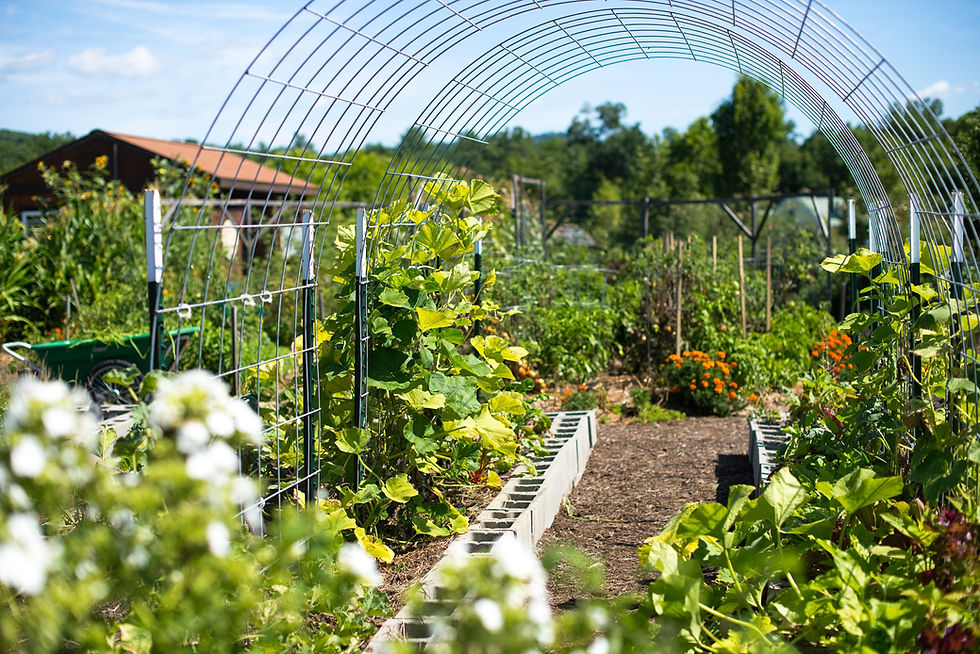
Winter Squash: Think Butternuts, Hubbards (my favorite), and Pumpkins. Unlike summer squash, these develop a thick "armor" that allows them to sit on a shelf in your pantry all winter long.
Grain Corn: This isn't sweet corn for summer BBQs; this is flint or flour corn meant for drying. Corn provides a massive amount of energy in the form of starch. When nixtamalized (processed with lime or wood ash), it becomes a nutritional powerhouse of B vitamins and minerals.
Dry Beans: Your shelf-stable protein. Growing crops like "Jacob’s Cattle," "Black Turtle," or "Scarlet Runner" beans provides a dense source of protein and fiber that requires no refrigeration and can be stored for years in simple glass jars.

2. The Perennial Pivot
Annuals are labor-intensive. You have to save seeds, prep beds, and sow every year.
Perennial Staples are the foundation of a long-term strategy—once established, they provide food year after year with minimal input.
Perennial Onions: Unlike standard onions that must be sown annually, perennial types provide a permanent source of pungent medicine and flavor.
Walking Onions: These grow "topsets" (miniature onions) at the top of the stalk, which eventually tip over and plant themselves, literally "walking" across your garden.
Potato Onions (Multiplier Onions): These grow in the ground like garlic, where one bulb planted turns into a cluster of many. They are incredibly shelf-stable.
Chives & Welsh Onions: These provide the first green bite of early spring, returning year after year with zero maintenance. Bonus points for their delightful edible blossoms that can be infused into vinegar for dressings.
Sunchokes (Jerusalem Artichokes): Often called "earth apples," these are virtually indestructible. They spread aggressively and provide a massive harvest of tubers in late fall. (Make sure to prepare them properly to prevent their infamous digestive issues)
Skirret (Sium sisarum): A forgotten medieval staple. This perennial root vegetable produces clusters of sweet, parsnip-like roots. It is incredibly hardy and thrives in damp soil.
Sorrel: A hardy perennial providing sharp, lemony greens in early spring—a reliable source of Vitamin C when the winter larder is low.
Lovage (Levisticum officinale): If you enjoy celery but don't want to have to do practically anything, try planting lovage instead. It doesn't produce thick stalks like celery, but the abundant leafy foliage takes just like celery (and it grows 3-6 feet tall so you only need 1-2 plants)
Asparagus & Rhubarb: Crops that emerge in early spring to provide the first fresh nutrients of the year, but are not worth growing, in my personal opinion, due to the amount of space they both take up relative to what they provide.

3. Native Alternatives: Tapping into the Commons
True sovereignty means looking at what the land wants to grow and giving back to the land. Native staples have sustained people for millennia without expensive inputs.
Camas (Camassia quamash): Pacific Northwest. A bulb that, when slow-roasted, becomes a sweet, dense carbohydrate source.
Groundnut (Apios americana): Eastern North America. A native vine producing protein-rich tubers that taste like nutty potatoes.
Checkermallow (Sidalcea spp.): These perennials offer edible leaves and flowers and are resilient to local climate fluctuations while supporting native pollinators.
Oak (Acorns): A high-fat, high-carb staple. Once leached of tannins, acorn flour is one of the most nutrient-dense wild foods available.
Black Walnut (Juglans nigra): black walnuts are not only edible but highly nutritious, featuring a rich, earthy, and bold flavor compared to English walnuts
Chestnuts & Hazelnuts: The "grains that grow on trees." They provide fats and proteins without the need for tilling the earth.
Chokecherry (Prunus virginiana): High in antioxidants and historically a key ingredient in pemmican—the ultimate survival food in many indigenous cultures.
American persimmon (Diospyros virginiana) Eastern & Southeastern US. A highly nutritious fruit known for its intense sweetness, custardy texture, and notes of caramel or honey when ripe. Dioecious, so separate male and female trees.
Pawpaw (Asimina triloba) Eastern North America. Tastes like a combination of citrus, mango, and banana and is most often eaten fresh.
Serviceberry, Elderberry, Thimbleberry, Huckleberry: Native shrubs providing antioxidant and vitamin-rich berries; they are far more resilient than imported fruit trees.

Moving from "Garden" to "Security"
A garden that can feed you through a crisis is powerful. A garden that can also heal you through one is something else entirely.
The most strategic plants you can grow aren't just calorie-dense or shelf-stable — they're multipurpose. They feed you, yes. But they also address the health challenges that inevitably arise when access to conventional care is limited... The inflammation from a physical injury... The respiratory infection moving through the household... The chronic stress and nervous system depletion that comes from living through instability...
The plants that bridge the gap between "food garden" and "home apothecary" are the ones worth knowing deeply — because a handful of the right ones, grown well and worked with skillfully, can cover more ground than an entire shelf of supplements.
This is the layer most survival gardening guides leave out entirely. And it's the one that, in my fifteen years of practice, makes the most meaningful difference in a household's actual resilience.
If you want to know which plants those are — and how to grow, harvest, and safely and effectively work with every part of them as food, medicine, skincare, and land restoration — that's exactly what my Resistance Gardening training is built around.
Don't forget to join my weekly newsletter to have more free herbal content sent to your inbox:
Thank you for taking care of yourself so that we can take care of each other <3
—Jovie



Comments